

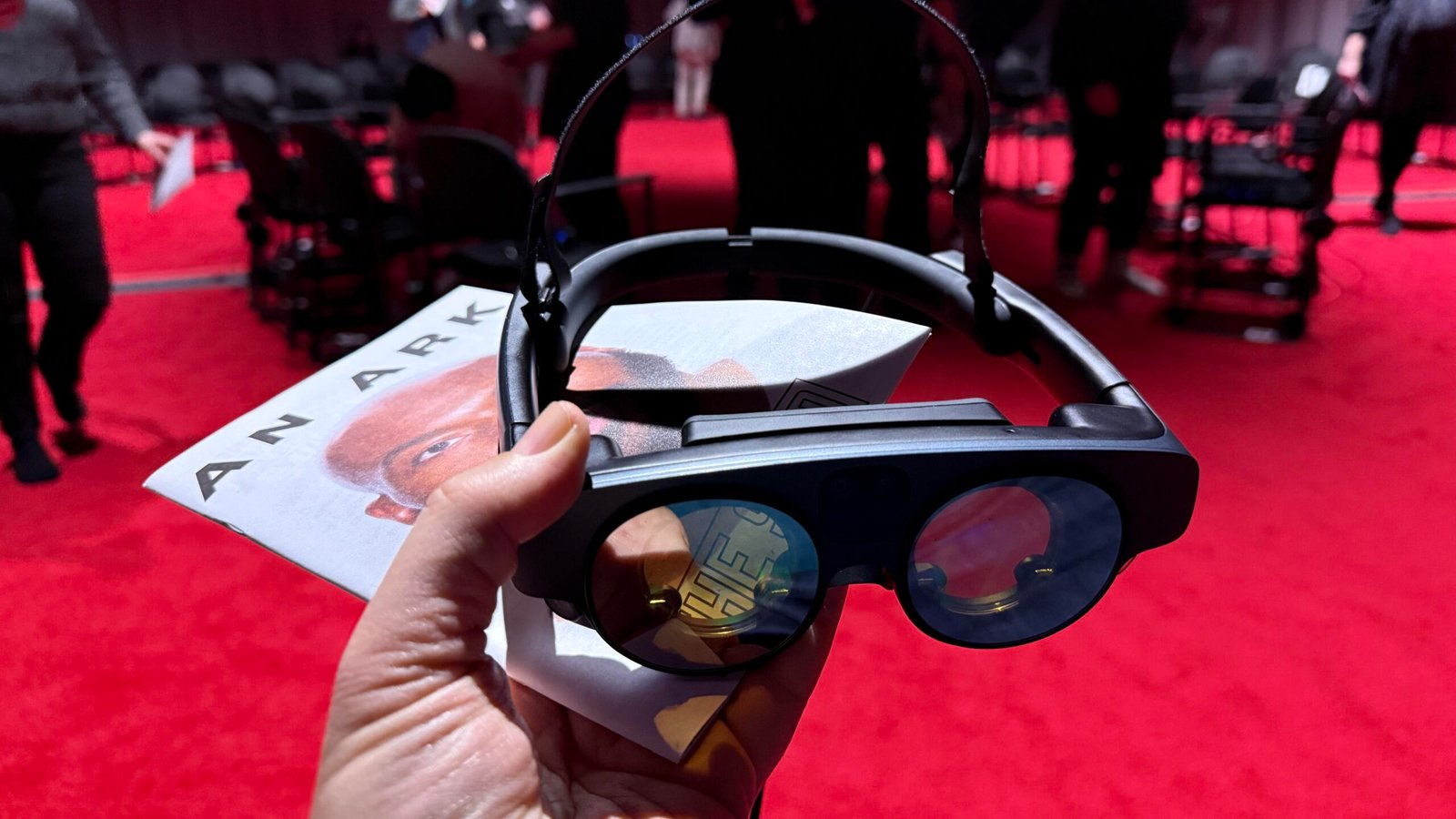
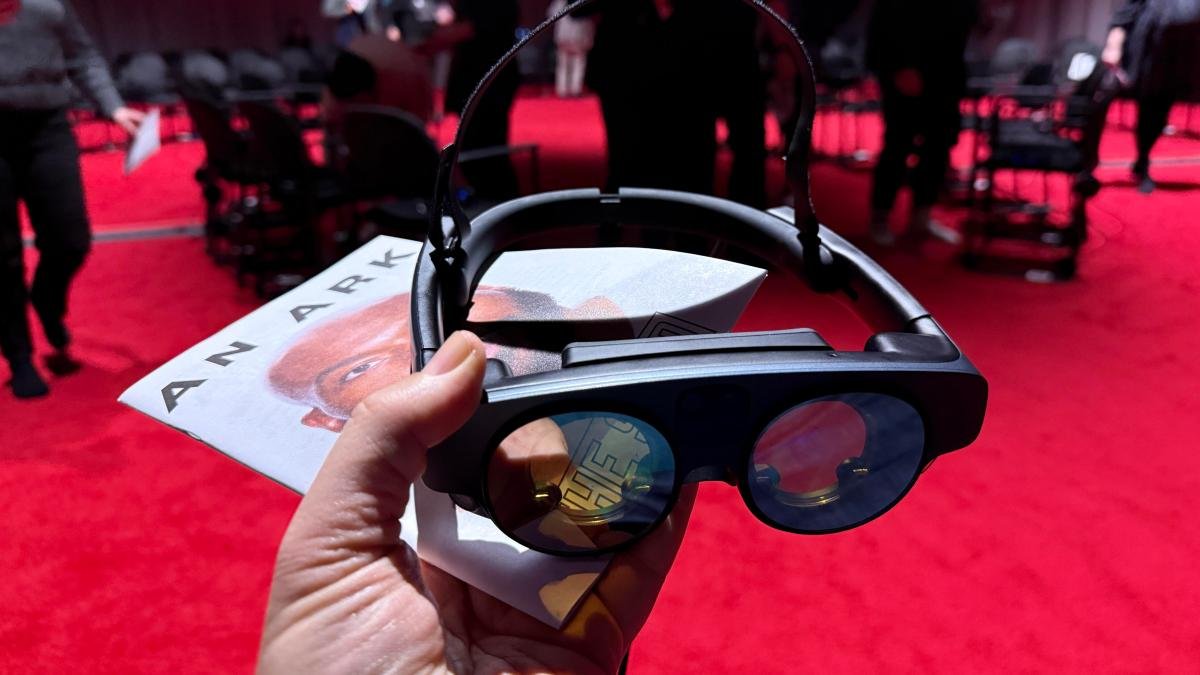
A pair of Magic Leap 2 glasses, which you’ll wear to see An Ark, a live theater production with no live actors.
Scott Stein/CNET
Recently, theatergoers at The Shed in New York City experienced An Ark, a groundbreaking 50-minute augmented reality play running until April 4, which uses Magic Leap 2 headsets to project holographic actors like Ian McKellen directly into the audience’s space to explore the emotional boundaries of human connection. The physical preparation for this digital experience requires a unique ritual: removing your shoes before stepping onto the carpeted stage. For those who wear prescription eyeglasses, there is an extra step, as the Magic Leap 2 hardware does not easily accommodate standard frames, forcing some attendees to swap their glasses for contact lenses in the restroom just before showtime.
Once inside the dimly lit, circular room, dozens of participants sit together, each wearing a tethered pair of AR glasses. Together, yet isolated in their individual visual feeds, the audience watches as lifelike, volumetric holograms of celebrated actors materialize in the center of the space. Billed as the first play created specifically for mixed reality, this ambitious 50-minute production marks one of the longest continuous uses of the Magic Leap 2 headset in a public setting. By the curtain call, the physical weight of the hardware becomes noticeable, leaving a warm sensation on the bridge of the nose and a distinct readiness to return to the natural world.
Attending the performance on a bitterly cold winter afternoon alongside a colleague, the lasting impression of the show remains deeply haunting. The experience delivers an emotional yet strangely detached atmosphere. It successfully captures the unmistakable energy of a live theatrical gathering, despite the absolute physical absence of any live actors on the stage.
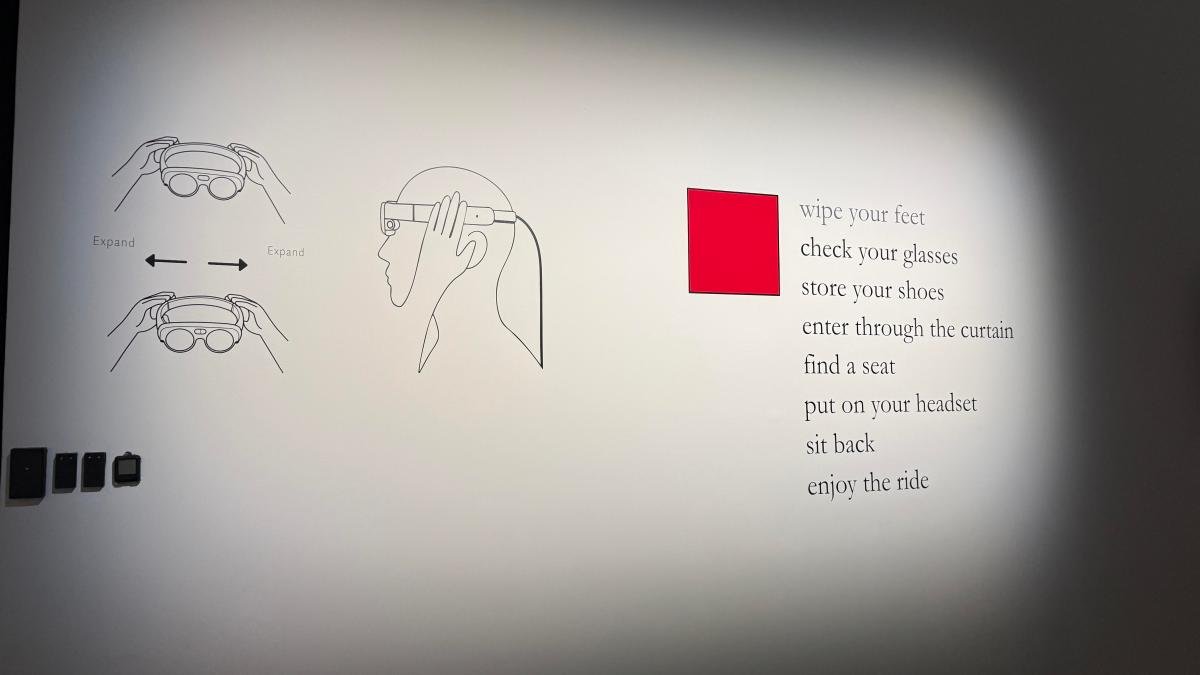
Hallways and walls invite you into the experience at An Ark, preparing you for how to put on the headset.
Scott Stein/CNET
The Illusion of Shared Presence and Intimate Acting
This technological shift raises pressing questions about the future of traditional, physical theater. Rather than aiming to replace flesh-and-blood performers, the production serves as a memorial-like meditation on the liminal state of existence after death. The narrative unfolds as four virtual chairs appear in a semicircle. One by one, the volumetrically captured cast—featuring Ian McKellen, Golda Rosheuvel, Arinzé Kene, and Rosie Sheehy—takes their places. Their digital presences are hypnotic, creating an uncanny sensation that they are sitting mere feet away, actively competing for the viewer’s attention through simulated eye contact.
Because the Magic Leap 2 headset features a restricted field of view, only about two of the virtual chairs fit within the display frame at any given moment. This limitation forces viewers to physically turn their heads to track the interactions. The actors address the viewer directly, establishing intense eye contact that blurs the lines of familiarity. While every audience member experiences the illusion of the actors sitting directly in front of them, no one can see what their neighbor is seeing. This shared yet deeply individualized multiplicity creates a powerful sense of collective bearing of witness, enhanced by a synchronized, room-filling ambient audio track that unites the physical space.
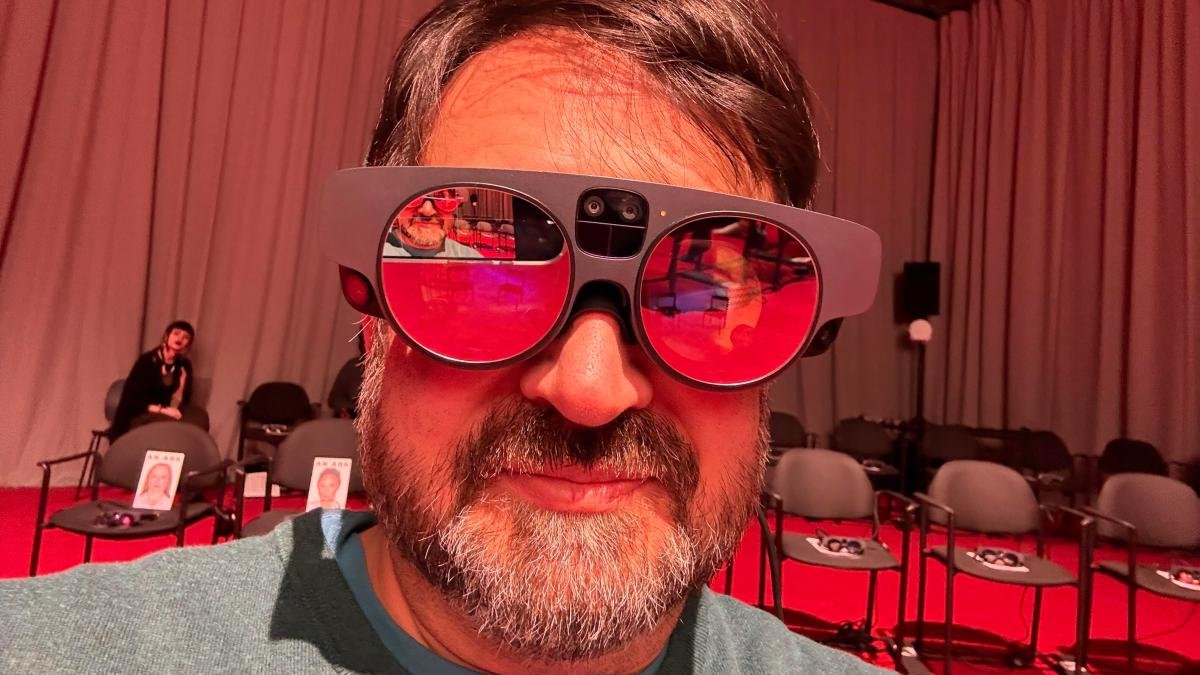
I had to take my glasses off and put contact lenses in. Look closely, and you can see the virtual chairs I see in the lenses of the Magic Leap 2 headset, barely.
Scott Stein/CNET
The Technical Hurdles of Shared Augmented Reality
Even in 2026, moments where augmented reality successfully blends with or replaces physical reality remain rare. AR hardware developers still face a fundamental challenge: designing virtual experiences that integrate safely and comfortably within a shared public space where participants may not see identical visual outputs. While consumer mixed-reality headsets like the Apple Vision Pro, Samsung Galaxy XR, and Meta Quest lines can place virtual elements into a user’s local environment, they are rarely worn in collaborative, public settings.
The Legacy of Magic Leap and Volumetric Theater
Magic Leap remains an early pioneer in the AR space. Todd Eckert, the producer of An Ark and the former head of content development for Magic Leap, has spent years pushing the boundaries of the medium. His previous hardware-driven theatrical productions include The Life, an art installation featuring Marina Abramović, and Kagami, an AR concert experience built around the late Ryuichi Sakamoto. An Ark builds directly upon this foundation, challenging audiences to accept digital representations of real actors. In an era dominated by artificially generated AI videos, this project stands out by presenting highly authentic, human performances in a virtual format.
While staging a closed, ticketed event like An Ark is a step toward communal AR, the long-term appeal of the medium remains uncertain once the initial novelty of smart glasses fades. For many in attendance, the show serves as a first-time introduction to advanced wearable tech. Exiting the 45-minute performance to retrieve stored shoes feels akin to emerging from a modern techno-ritual. While a similar experience could theoretically be accessed at home, it would lack the essential element of shared human presence. Despite the $45 ticket price and the cold commute to Manhattan’s west side, the venue provides a unique sense of virtual togetherness that home environments cannot replicate.
The impact of the performances is heavily amplified by the intimate viewing distance. While holographic training programs exist on consumer platforms like the Meta Quest, experiencing high-caliber acting in a clean, distraction-free environment feels uniquely artistic. However, hardware limitations persist. The lack of universal prescription lens support remains a hurdle for smart glasses. Although the production offers prescription inserts, they only accommodate corrections up to -5, leaving those with stronger prescriptions, such as a -6, without a perfectly clear view.
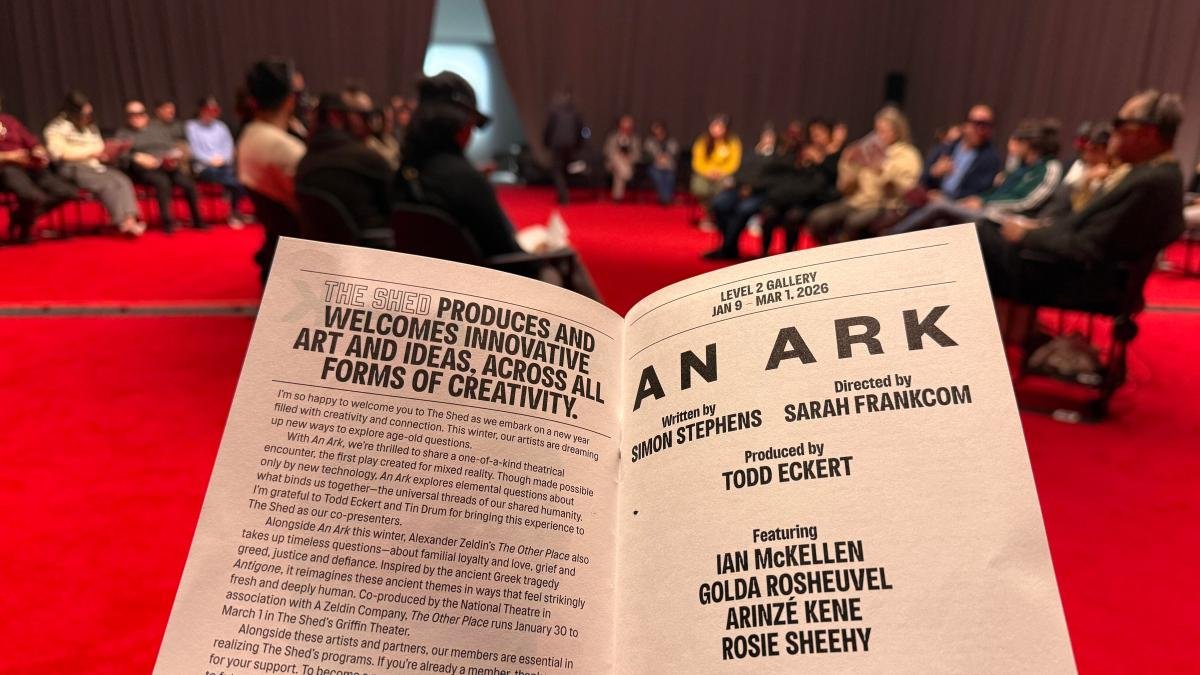
My “I’m at a real play” senses were activated, even though no live actors were actually there.
Scott Stein/CNET
A Renewed Appreciation for the Physical World
Ultimately, An Ark succeeds in anchoring its audience to a physical location. The memory of the physical room, the shared presence of other viewers, and the tactile ritual of removing shoes all contribute to a lasting sense of reality. As the four holographic characters—acting as modern spirits navigating the boundary between life and death—share interconnected memories of past lives, the narrative leaves a profound impact on the observer. Stepping back out into the city, the experience fosters a renewed appreciation for being alive and participating in physical theater, even in the absence of live performers. As wearable technology continues to evolve and attempt to reshape daily surroundings, the tangible, stable, and rich nature of the physical world remains irreplaceable, and this production highlights that reality through the lens of the virtual.