


Google patched a record-breaking 1,072 security vulnerabilities in its Chrome browser globally this June, leveraging its internal AI tools to rapidly eliminate flaws and outpace malicious hackers.
The AI-driven surge in vulnerability patching
The technology giant announced on Thursday that it successfully resolved 1,072 security flaws across the two latest versions of Chrome, both launched in June. This figure surpasses the cumulative total of 1,036 patches deployed across the previous 23 versions over a two-year period, highlighting a massive acceleration in defensive capabilities.
Since the rise of Large Language Models (LLMs), cybersecurity analysts have cautioned that AI-driven systems would identify vulnerabilities at an exponential rate, necessitating defensive teams to adopt AI tools to maintain an advantage over cybercriminals.
This forecast is now materialising, supported by concrete data.
Milestones and exponential growth
An official chart published by Google, released alongside a comprehensive white paper detailing its AI-assisted vulnerability discovery and patching initiatives, illustrates this dramatic upward trajectory. For context, Chrome version 126 was released in June 2024, whereas the two most recent iterations, Chrome 149 and 150, rolled out last month. Google categorises each major update as a “milestone”.
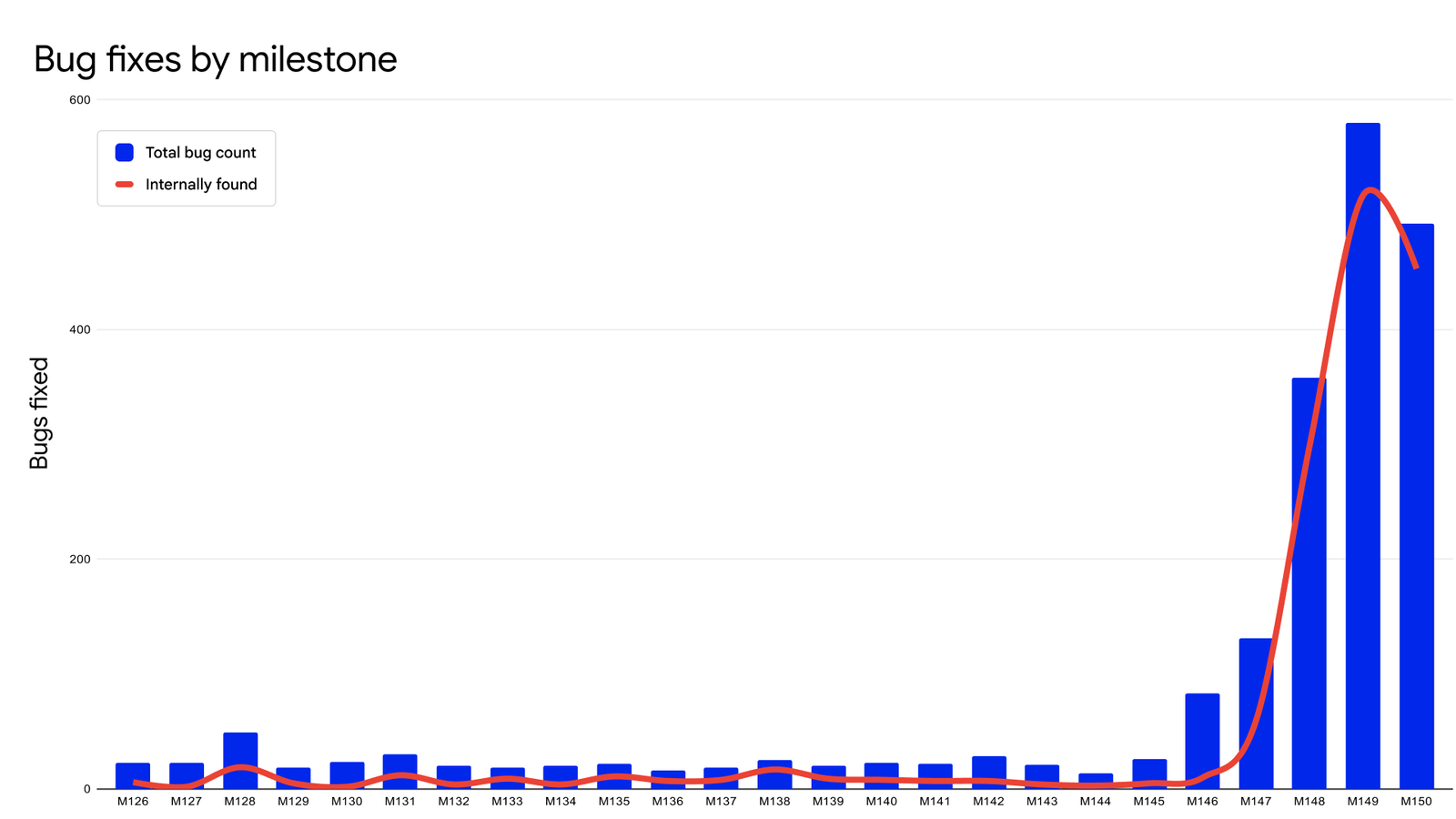
Doug Turner, Chrome’s director of engineering, stated to TechCrunch that LLMs have fundamentally altered the economics of cybersecurity, turning vulnerability detection into an automated, industrial-scale operation.
“By deploying models such as Gemini, we are proactively addressing vulnerabilities, staying ahead of threat actors, and strengthening Chrome’s defences with every single update,” Turner explained.
Industry-wide shift: Microsoft vs Apple
Google is not alone in witnessing this paradigm shift. Earlier this month, Microsoft disclosed that it had resolved a record 570 security flaws across its software suite during its monthly “Patch Tuesday” release cycle, attributing this massive surge directly to its integration of artificial intelligence.
Conversely, Apple does not seem to be experiencing a similar exponential spike. According to an independent count of resolved vulnerabilities, Apple has patched 482 flaws in 2026. This puts the company on a similar trajectory to its previous year’s performance and aligns closely with its patching metrics from 2015.
TechCrunch contacted Apple for comment regarding these figures, but received no response prior to publication.