

In August 2016, a mysterious hacking collective known as the Shadow Brokers shook global intelligence agencies by leaking highly classified cyberweapons stolen from the US National Security Agency (NSA)—an unprecedented security breach that remains completely unsolved today.
The Digital Ghosts of Cybersecurity
While modern cybersecurity defences continue to advance, the digital landscape remains littered with historic data breaches that have never been resolved. Decades after these intrusions, many of the most prolific hacking groups continue to evade unmasking by international law enforcement.
Of course, many high-profile cybercriminals do eventually face justice. This is true for members of LAPSUS$, the notorious extortion syndicate that compromised tech giants like Microsoft and Nvidia before facing multiple arrests. Similarly, state-sponsored cyber-espionage units from Russia and China have seen their operatives named, indicted, and placed on international most-wanted lists.
Despite these successes, some of the most compelling mysteries in digital espionage remain wide open, leaving investigators without suspects, answers, or clear motives. This exploration of unsolved cyber mysteries begins with one of the most bizarre intelligence leaks in modern history.
The focus of this investigation is the Shadow Brokers—an enigmatic collective that materialised online, published a devastating repository of highly classified hacking tools linked to the NSA, and then vanished without a trace.
An Unprecedented Auction of Cyberweapons
During the summer of 2016, whilst geopolitical tensions flared over Russian interference in the US presidential elections, the group suddenly appeared on Twitter. They shared a link to a Pastebin post and tagged various media outlets—a clumsy outreach method that meant most journalists initially overlooked the messages.
However, those who did click the link discovered an extraordinary invitation titled “Equation Group Cyber Weapons Auction — Invitation”. This was a direct reference to the elite cyber-warfare unit widely understood to be operated by the NSA.
“!!! Attention government sponsors of cyber warfare and those who profit from it !!!! How much you pay for enemies’ cyber weapons?” the hackers wrote, boldly claiming they had breached the defences of the Equation Group.
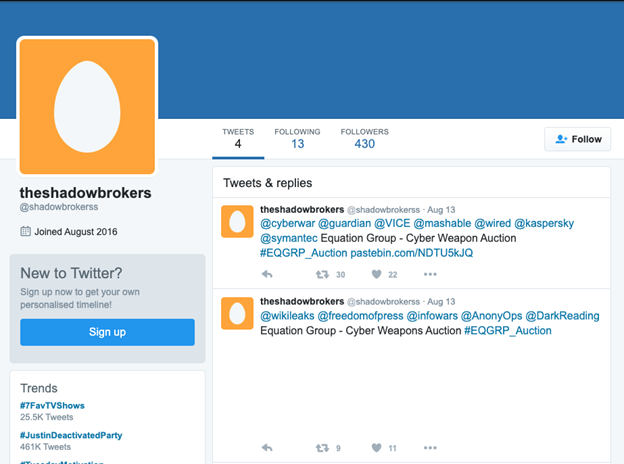
The published document contained links to download sample hacking tools alongside an encrypted file, which the group promised to decrypt for the highest bidder. “Auction files better than Stuxnet,” they claimed, referencing the infamous cyberweapon deployed against Iranian nuclear facilities in a joint US-Israeli operation in 2007. To secure the full cache, they demanded a starting bid of 1 million Bitcoin.
News of the leak spread rapidly. As global security researchers analysed the sample exploits, they quickly realised these were incredibly sophisticated cyberweapons. Evidence suggested they had been stolen directly from the NSA, a theory supported by code names that matched classified programmes previously exposed by whistleblower Edward Snowden.
A Bizarre Persona and Unanswered Questions
The auction itself was likely a distraction, as the group went on to dump the majority of the tools publicly months later. Indeed, much of the Shadow Brokers’ behaviour was baffling. Their poorly translated, broken English felt almost performative, suggesting they were deliberately masking their true identity. Despite craving attention and dominating headlines, the group granted only one brief interview to journalist Joseph Cox, who was reporting for VICE Motherboard at the time.
Almost a decade later, the true identity behind the Shadow Brokers remains a complete mystery. Investigators and journalists have interviewed former NSA staffers who speculated that a rogue insider might have been responsible. Yet, no one has ever been arrested or charged—an astonishing failure given this represents one of the most damaging intelligence compromises in US history.
Early suspicions fell on Harold T. Martin III, an NSA contractor arrested for hoarding classified documents. However, this theory fell apart when the Shadow Brokers continued their online activities whilst Martin was in federal custody. He was never charged in connection with the leaks. Today, the most widely accepted theory among intelligence experts is that the persona was a front created by a Russian state intelligence agency for geopolitical propaganda.
The Devastating Global Impact of EternalBlue
The real-world consequences of the leak were catastrophic. Foremost among the released exploits was EternalBlue, a devastating zero-day exploit targeting Microsoft Windows. This vulnerability allowed attackers to compromise networks silently, escalate privileges, and launch self-propagating worms. Because these were zero-day flaws—meaning they were unknown to Microsoft and lacked security patches—the world was defenceless.
North Korean state hackers quickly weaponised EternalBlue to launch the WannaCry ransomware epidemic. Shortly after, Russian military hackers integrated it into the NotPetya malware, which spread far beyond its Ukrainian targets, causing over $10 billion in global damage. For the corporate world, the lesson was clear: cyberweapons hoarded by intelligence agencies cannot remain secure forever, and when they leak, businesses bear the cost.
The Legacy: Uncovering Fast16
Years later, the leaked data continue to yield startling revelations. Hidden within the repository was a list of project codenames, including one cryptically labelled “Fast16” alongside the warning: “NOTHING TO SEE HERE — CARRY ON.”
Last month, security researchers revealed they had finally located and analysed this component. They discovered highly sophisticated malware dating back to 2005, engineered to sabotage software reportedly used by Iranian nuclear scientists—proving that the legacy of this unsolved mystery is still unfolding today.